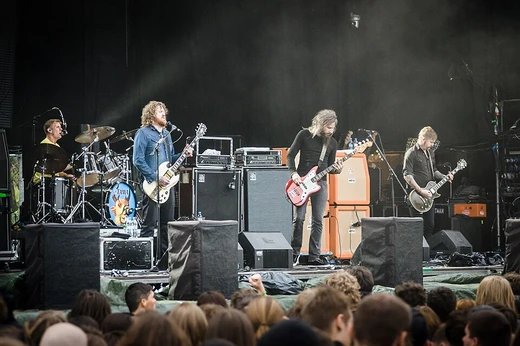
Arch Echo
American instrumental progressive metal band from Nashville.

Arch Echo is an instrumental progressive metal band that came together in Nashville, Tennessee, in 2016. The lineup has remained steady since then: Joey Izzo on keyboards, Adam Rafowitz and Adam Bentley on guitars, Joe Calderone on bass, and Richie Martinez on drums. The group has put out three full-length albums—Arch Echo (2017), You Won’t Believe What Happens Next! (2019), and Final Pitch (2023)—the last of which includes guest spots from Jordan Rudess, Anthony Vincent, and Adrián Terrazas-González. They’ve shared stages with Dream Theater, Periphery, Plini, VOLA, and Jacky Vincent, and also contributed to Jacob Collier’s track “100,000 Voices” from his album *Djesse Vol. 4*.
Their sound, as described by New Noise Magazine, mixes the high-speed, technical flair of classic prog-metal acts like Steve Vai and Dream Theater with the riff-heavy djent of Animals as Leaders and Periphery, plus the looser, jazz-influenced grooves of Polyphia and Plini. Additional influences include Rush, Allan Holdsworth, Cynic, and Meshuggah. The band has also released two EPs: *Story I* (2020) and *3X3: Catalyst* (2025).
- formed
- 2016
- origin
- Nashville, Tennessee, United States
- field
- Instrumental progressive metal
- members
- Joey Izzo, Adam Rafowitz, Adam Bentley, Joe Calderone, Richie Martinez
- studio_albums
- 3
Lore & Background
Arch Echo formed in 2016 while its members attended the Berklee College of Music. The band released its self-titled debut album Arch Echo in 2017, followed by You Won’t Believe What Happens Next! in 2019 and Final Pitch in 2023. The latter album featured guest appearances from Jordan Rudess, Anthony Vincent, and Adrián Terrazas-González. The band has toured with Dream Theater, Periphery, Plini, VOLA, and Jacky Vincent, and contributed to Jacob Collier's song '100,000 Voices' from the album Djesse Vol. 4.
Reader's Guide
Arch Echo occupies a distinct space in instrumental progressive metal, combining the speed and virtuosity of classic artists like Steve Vai and Dream Theater with the rhythmic complexity of djent bands such as Animals as Leaders and Periphery. Their music also incorporates the hip-shaking, jazzy style popularized by Polyphia and Plini, as noted by New Noise Magazine. The band's three studio albums—Arch Echo (2017), You Won’t Believe What Happens Next! (2019), and Final Pitch (2023)—demonstrate a consistent evolution in their sound. Their collaborations with prominent musicians and tours with major acts in the genre have solidified their reputation among fans of technical, melody-driven instrumental metal. The band's legacy lies in their ability to merge disparate influences—from Rush and Allan Holdsworth to Cynic and Meshuggah—into a cohesive, energetic style that appeals to both purists and newer listeners of progressive metal.
Did You Know?
- Arch Echo formed in 2016 while its members attended the Berklee College of Music.
- Their 2023 album Final Pitch featured guest appearances from Jordan Rudess, Anthony Vincent, and Adrián Terrazas-González.
- The band contributed to Jacob Collier's song '100,000 Voices' from the album Djesse Vol. 4.
- New Noise Magazine described their style as mixing 'sheer speed and general wankery' with djent and jazzy elements.
Frequently Asked Questions
What is Arch Echo?
Arch Echo is an instrumental progressive metal band that formed in Nashville, Tennessee, back in 2016. They focus entirely on wordless, composition-driven metal rather than vocal performances.
Who are the members of Arch Echo?
The lineup has stayed consistent since the band's inception: Joey Izzo handles keyboards, Adam Rafowitz and Adam Bentley play guitars, Joe Calderone is on bass, and Richie Martinez sits behind the drums.
What studio albums has Arch Echo released?
The band has put out three full-length records: their self-titled debut in 2017, You Won't Believe What Happens Next! in 2019, and Final Pitch in 2023.
Who has Arch Echo toured or shared stages with?
They've opened for or played alongside major names in the prog-metal world, including Dream Theater, Periphery, Plini, VOLA, and Jacky Vincent.
What's special about Arch Echo's album Final Pitch?
Released in 2023, Final Pitch stands out for featuring guest contributions from Jordan Rudess, Anthony Vincent, and Adrián Terrazas-González. It marks the band's most high-profile collaboration to date.
More in American progressive metal musical groups 1-24
Spotted an error? Know more?
This is a living reference — every entry is fact-audited, and reader corrections feed straight into our audit queue. Suggest an edit · See this site's audit record